
The best of both worlds: a fault-tolerant compound photon-atom quantum architecture
The tension
A useful quantum computer has to clear two bars simultaneously: millions of physical qubits running well below the error-correction threshold, and enough connectivity to entangle qubits that are nowhere near each other. No hardware platform clears both on its own.
Matter-based qubits — superconducting circuits, trapped ions, neutral atoms — deliver excellent control and high gate fidelity. Connectivity is where they struggle. Superconducting chips are largely confined to a flat, nearest-neighbor grid. Trapped ions run into motional-mode crowding as chains grow. Neutral atoms can be shuttled to reconfigure connectivity, but both shuttling and readout are slow, pushing error-correction cycles into the millisecond range — roughly a thousand times slower than superconducting platforms.
Photons invert the trade-off entirely. They barely interact with their environment, need no dilution refrigerator or ultra-high vacuum, and once entangled, offer essentially unlimited connectivity — tailor-made for measurement-based quantum computing (MBQC). The cost shows up earlier, at the point of generating that entanglement: linear optics has no built-in nonlinearity for a deterministic entangling gate, so purely photonic platforms fall back on probabilistic operations and heralding, at a price of roughly six orders of magnitude in extra source and gate resources to reach utility scale.
Two platforms, two complementary weaknesses. Our new blueprint, posted to arXiv, doesn't resolve the tension by picking a winner — it resolves it by combining their strengths.
The idea: let each qubit type do what it's good at
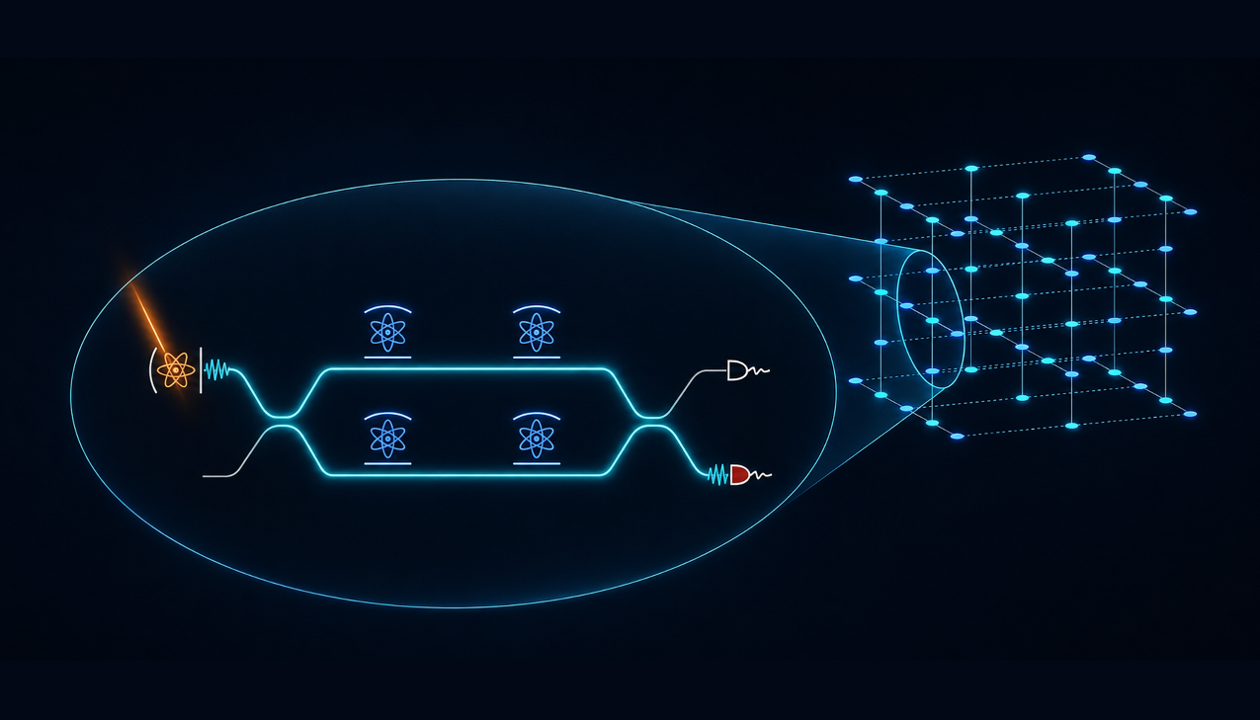
Our compound photon–atom architecture assigns each qubit type the job it's actually suited for. Photons and atoms both carry logical information, but photons handle modularity and long-range connectivity, linking qubits across the machine, while atoms serve as reusable entanglement sites and short-term quantum memories. In our implementation, each atomic qubit is a single rubidium-87 atom trapped inside a high-finesse Fabry–Pérot cavity.
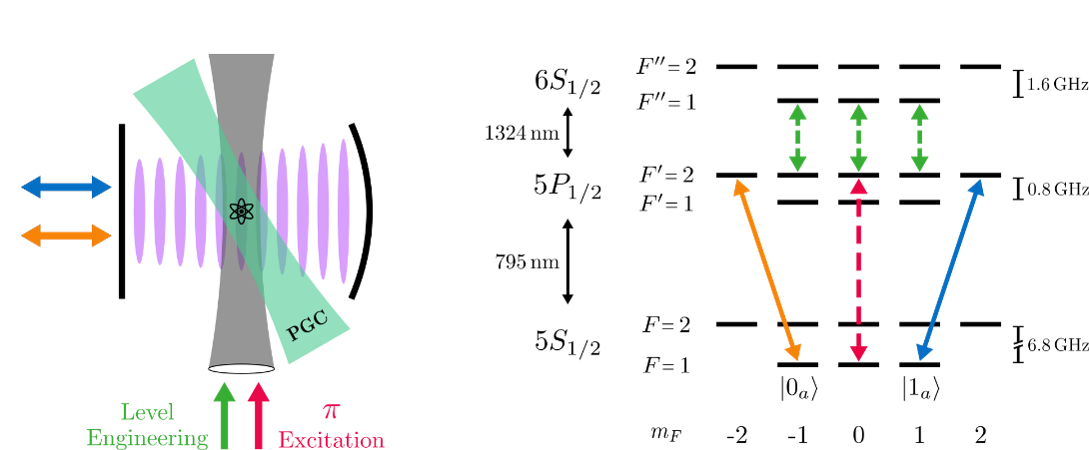
The design turns on one operation: the entangling gate between a photon and an atom. Where a purely photonic gate is probabilistic, this one succeeds with near certainty on every attempt. A photon is sent to interact with a single atom held inside a small, high-quality optical cavity — the regime of cavity quantum electrodynamics (cavity QED) — where the two couple strongly enough to exchange information reliably. The interaction is built to absorb small imperfections without breaking, and it shuts down stray atomic transitions before they become errors. The same atom-in-a-cavity system prepares and reads out atomic states and generates single photons on demand, all on timescales of tens of nanoseconds. Together, these are the raw ingredients from which the building blocks of fault-tolerant computation are assembled, all expressed in the language the hardware actually speaks.
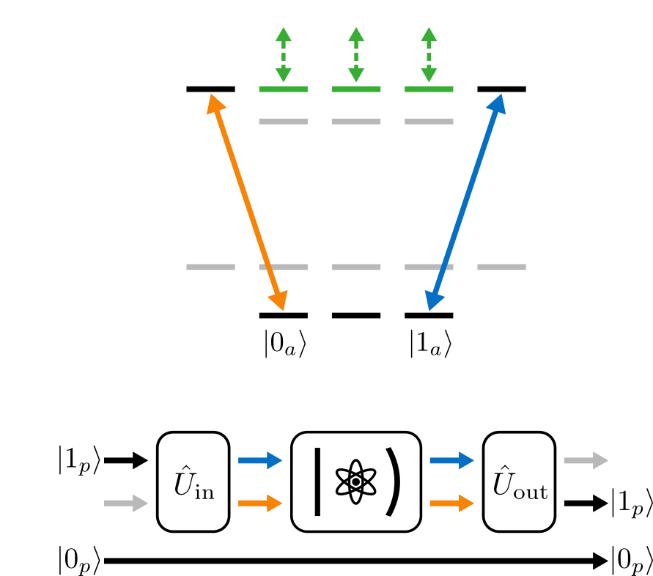
Direct photon–atom interaction buys us something else, too: neither strict photon indistinguishability nor the massive hardware overhead that probabilistic gates demand is necessary here.
From unit cells to fault tolerance
With most of the qubits photonic, computation runs naturally in the MBQC framework: build one large entangled cluster state, then measure it layer by layer. We construct the Raussendorf–Harrington–Goyal (RHG) lattice — the surface code written as a three-dimensional cluster state — and its bipartite structure maps directly onto our hardware, one sublattice photonic, the other atomic. Once an atom completes its entangling gates, its state is mapped onto a photon, gets measured, and the atom is reset for the next round. That recycling, combined with photonic delay lines, cuts the number of cavities and control components by more than an order of magnitude.
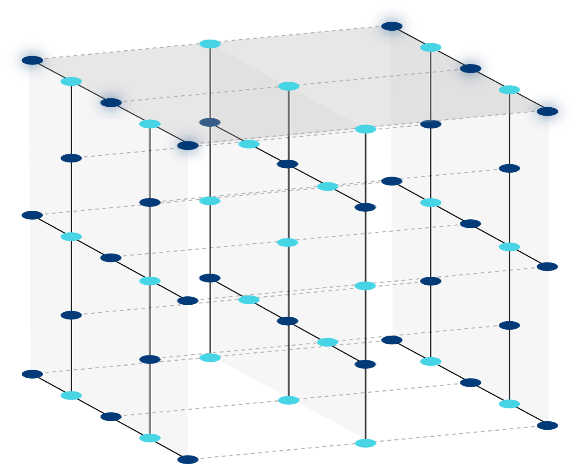
Storage is only half the job — the architecture also runs the logic. The core gate set (Hadamard, phase, CNOT) applies directly and cheaply, containing errors before they spread, by exploiting the platform's long-range connectivity instead of the heavier machinery of standard lattice surgery. Universal computation needs one more piece: the non-Clifford T-gate. We give two routes to the resource states it requires, both built entirely from operations the platform already performs natively.
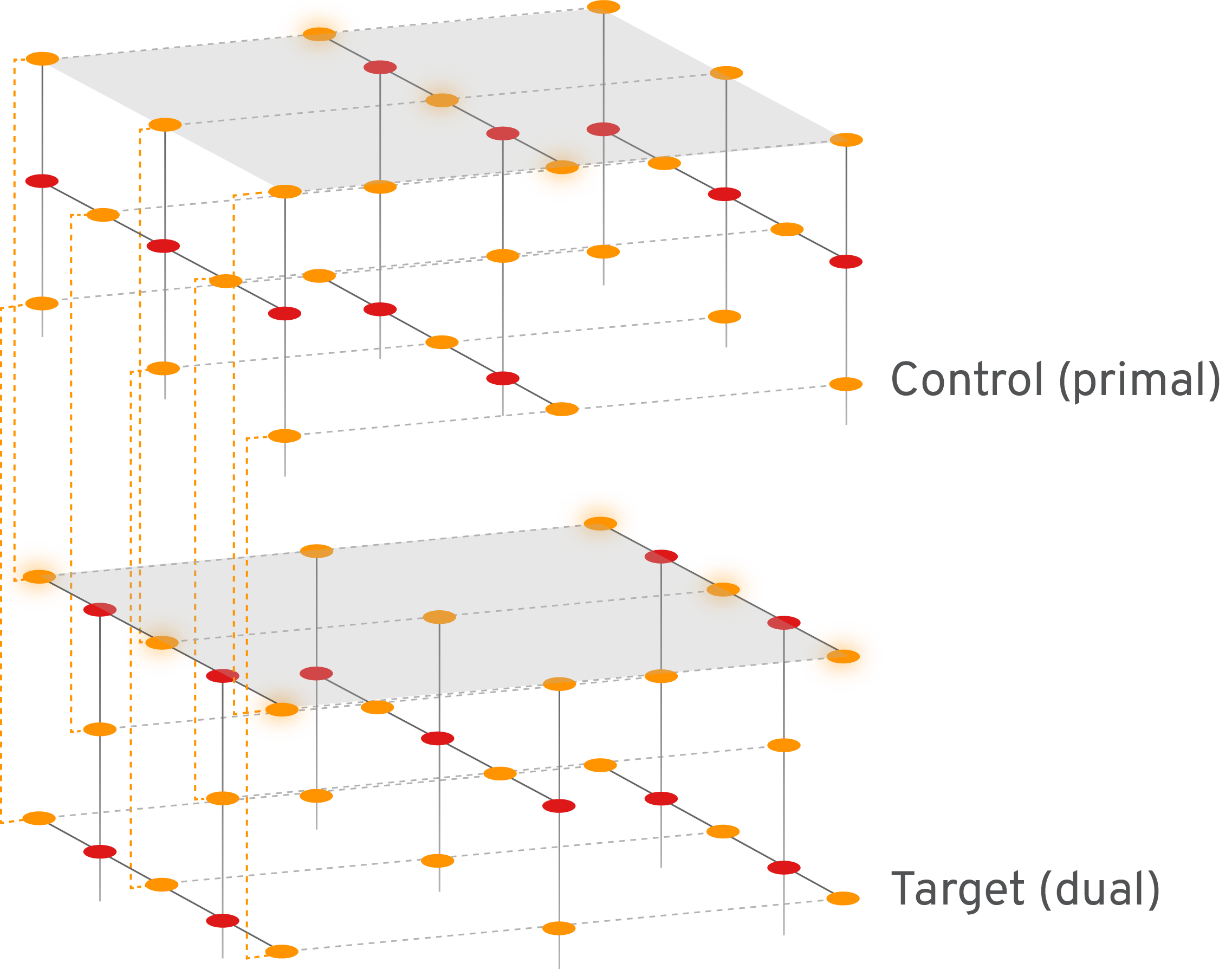
With the architecture in place, the remaining question is how it holds up under realistic noise. The blueprint presents a noise model tailored to our hardware rather than borrowing a generic one. It captures the asymmetric loss processes specific to the platform and, importantly, bond-loss propagation: when a photon is lost mid-sequence, the missing entangling bonds quietly corrupt neighboring error-correction checks without leaving an obvious signature. Handling this correctly — rather than with the pessimistic approximations common in the literature — lets our loss-aware decoder preserve optimal distance scaling.
The key figure to come out of this model is the photon-loss threshold: about 2.6% per physical gate, or roughly 15% total loss across a photon's full trajectory through the machine. Logical Clifford gates reach the same threshold as the memory channel itself.
Why we think this matters
No single number tells the story here — the combination does. Deterministic entanglement removes the photonic platform's defining bottleneck. Tens-of-nanosecond operations remove the matter platform's speed penalty. Photonic connectivity removes the geometric constraints that complicate code design, opening a path toward more hardware-efficient error-correcting codes (qLDPC codes) — codes that depend on exactly the long-range connectivity this platform provides natively. And short-term atomic memory adds a quieter advantage: a timing degree of freedom that lets you delay photon generation and routing until the right atomic resources are ready, easing the burden on switching and classical processing.
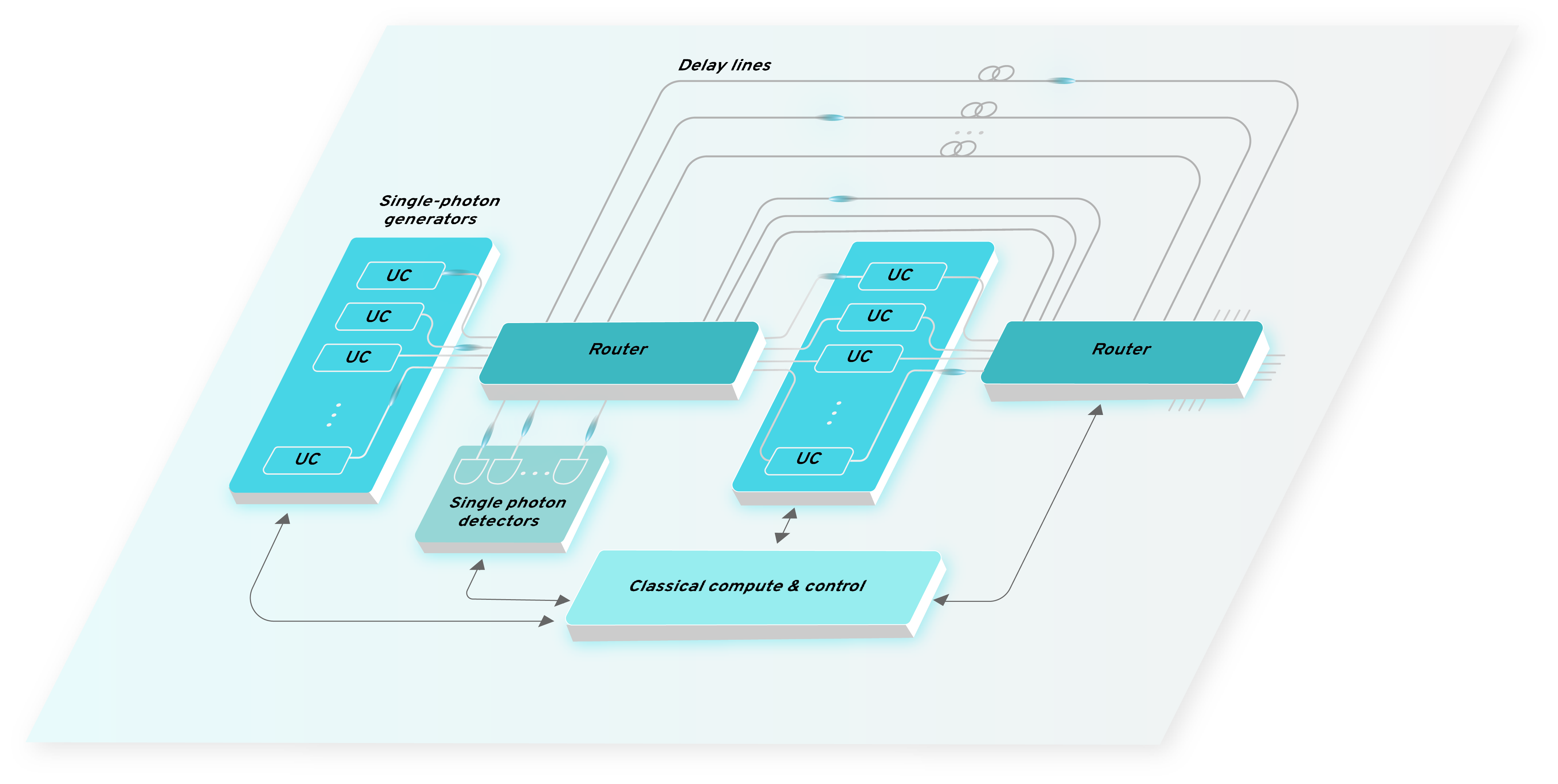
A blueprint is not a finished machine. The engineering ahead is real: large-scale optical integration, improved cavity fabrication, fast switching infrastructure, powerful classical compute and control, full system-level optimization. Useful computation demands operating comfortably below threshold, not at its edge. But the physical layer and the fault-tolerance framework now share one foundation — and that's the part we set out to build.
The full paper is available on arXiv: Geva Arwas, Doron Azoury, Daniel Azses, Orel Bechler, Dana Ben Porath, Barak Dayan, David Dentelski, Yaron Jarach, Nadav Kandel, Aviad Landau, Yair Margalit, Alexander Poddubny, Michael Slutsky, and Konstantin Yavilberg,"Blueprint for a fault-tolerant compound photon-atom quantum architecture," arXiv preprint arXiv:2606.30385 (2026).
categories
popular
Similar
The meaning of practical & useful quantum computing
The real quantum revolution will begin when quantum computers become affordable and cost effective to scale. Quantum Source paves the way for practical, fault...
A photon controls a photon: a single atom router
Following the transistor footsteps with single photons opens the path to scalable photonic quantum computation.
SWAP - the most fundamental unit of communication in nature
Realizing a unitary exchange of qubits between light and matter carries both fundamental and practical significances.

Quantum information processing with photonic and atomic qubits
The interaction between photonic and matter qubits represents an exciting and promising avenue for the development of quantum computers.
popular
V-Quantum computing, national competitiveness, and the road to fault-tolerant
Former Israeli Prime Minister Naftali Bennett joins The Quantum Insider to discuss the future of quantum computing, the global quantum race, and why he believes photonic quantum computing offers the most scalable path to fault-tolerant quantum computers.
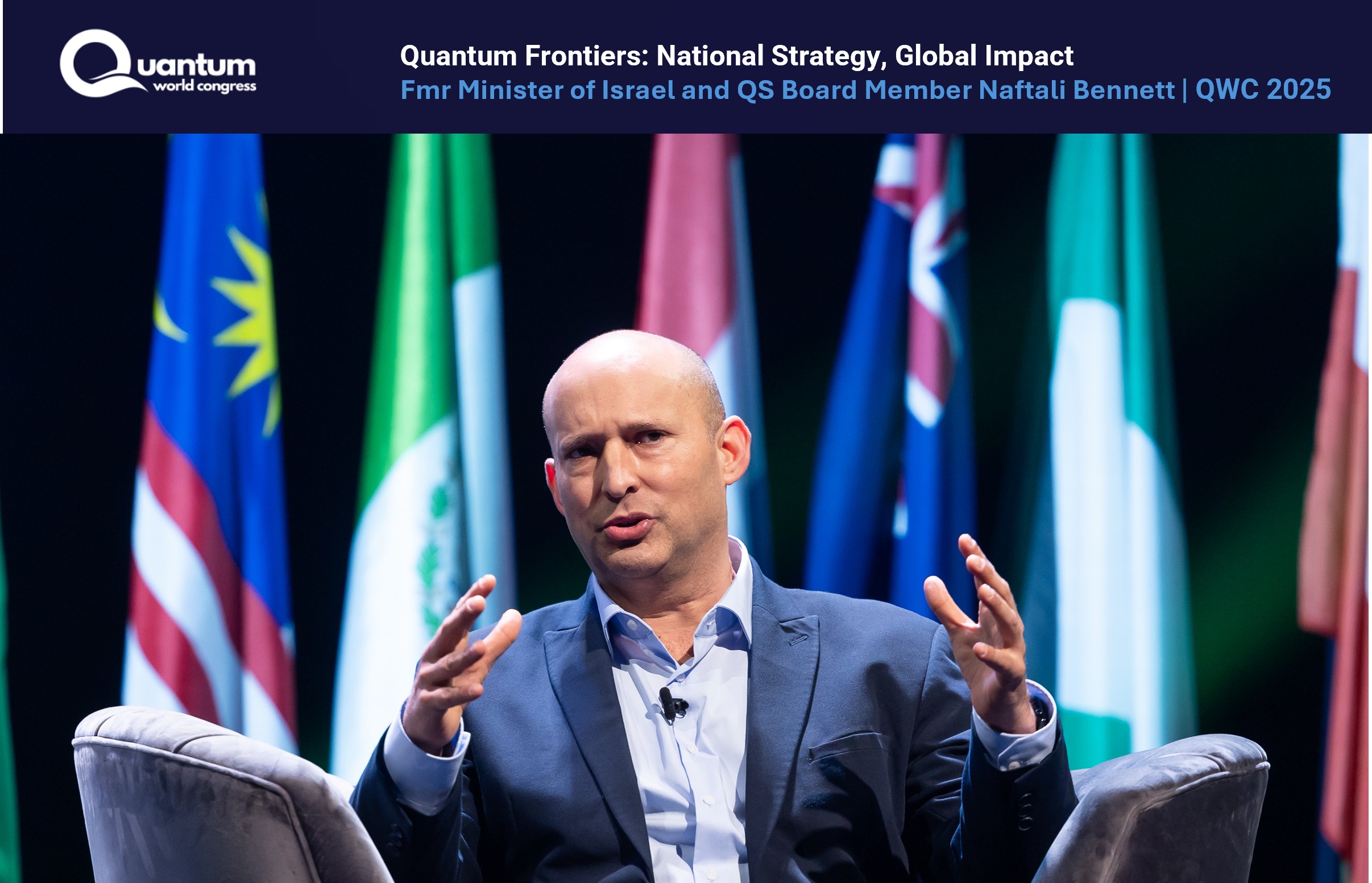
V-Quantum Frontiers: National Strategy, Global Impact
At QWC 2025, former Prime Minister of Israel and Quantum Source Board Member Naftali Bennett joined Preston Dunlap, former inaugural CTO and Chief Architect of the U.S. Space Force & Air Force and founder of Arkenstone Ventures, for a timely discussion on how nations and companies can navigate the pivot from promise to practical quantum capability.
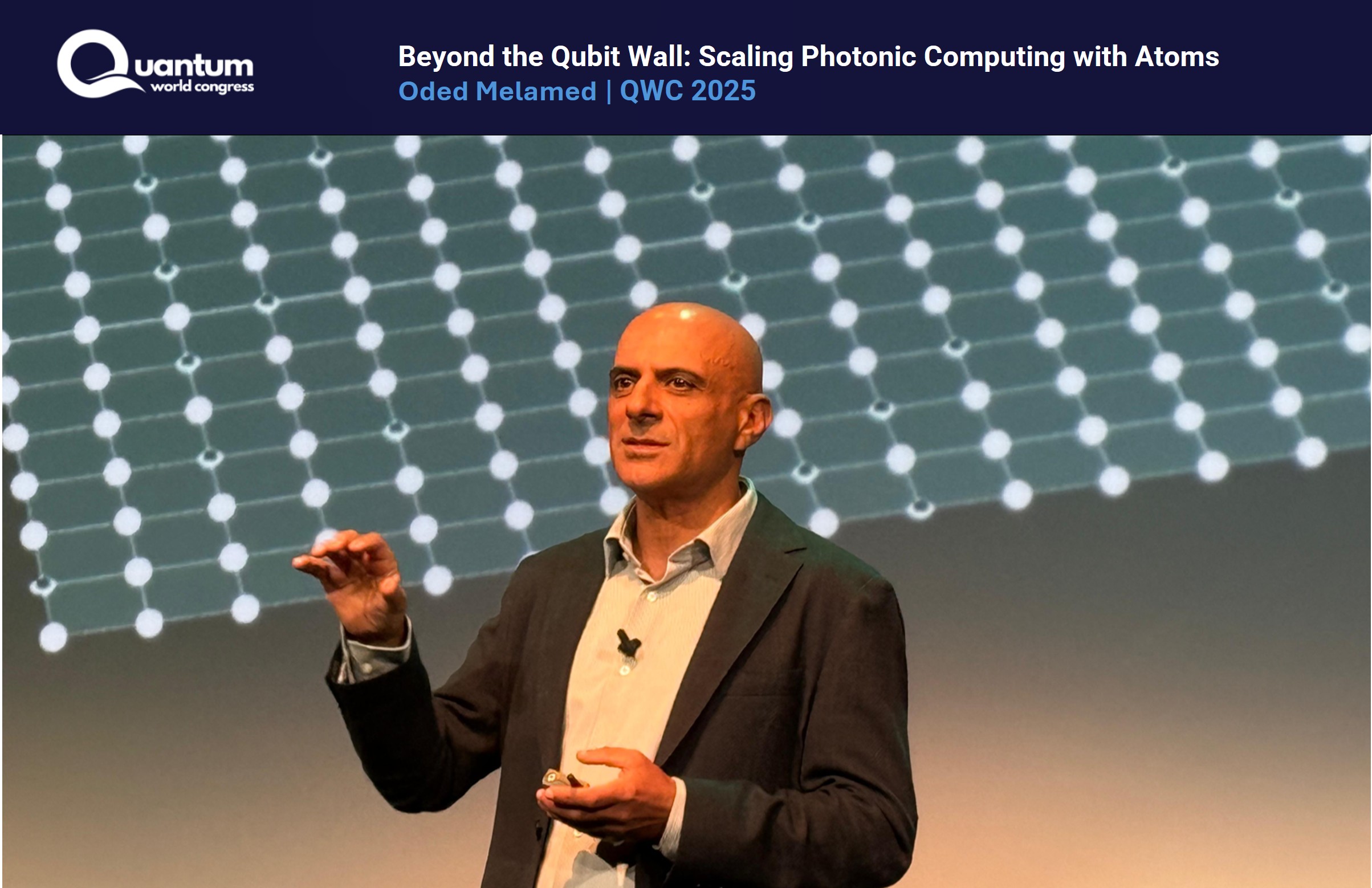
V-Beyond the Qubit Wall: Scaling Photonic Computing with Atoms
At QWC 2025, Quantum Source laid out how photonics could leap from probabilistic lab demos to room-temperature, fault-tolerant systems. In a tightly argued talk, CEO Oded Melamed described a hybrid approach that couples single photons with single atoms on one platform, aiming to make resource-state generation deterministic and compact enough for a standard server room.
popular
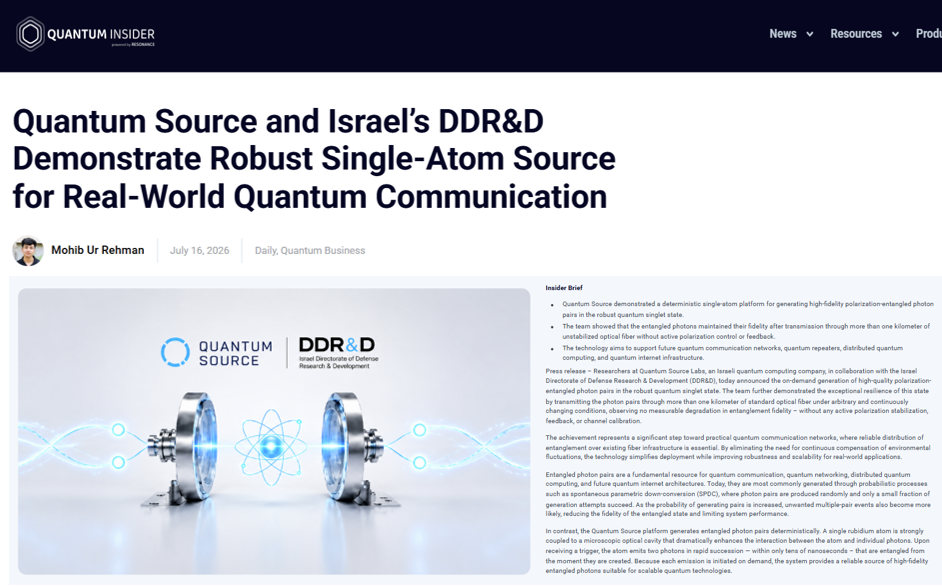
N-Quantum Source and DDR&D Demonstrate Robust Single-Atom Source for Real-World Quantum Communication
Quantum Source and the Israel DDR&D announced the on-demand generation of high-quality polarization-entangled photon pairs, successfully transmitting them through over one kilometer of standard optical fiber.
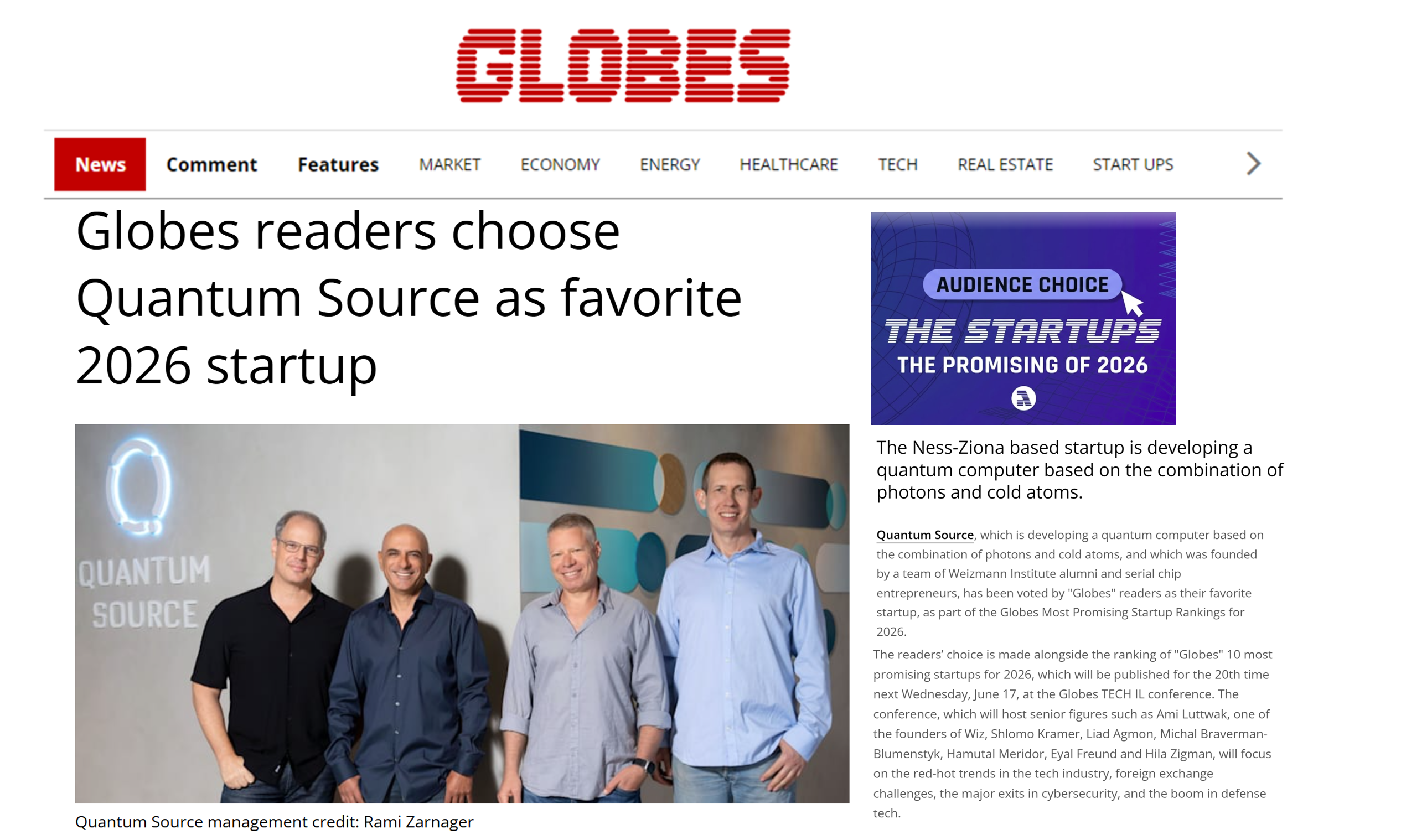
N-Globes readers choose Quantum Source as favorite 2026 startup
Quantum Source, which is developing a quantum computer based on the combination of photons and cold atoms, and which was founded by a team of Weizmann Institute alumni and serial chip entrepreneurs, has been voted by "Globes" readers as their favorite startup, as part of the Globes Most Promising Startup Rankings for 2026.

N-Quantum Source Delivers Practical Photonic Quantum Computing
In this Forbes exclusive interview, published just ahead of Quantum World Congress, Gil Press highlights how Quantum Source’s atom-photon technology is paving the way toward scalable, fault-tolerant photonic quantum computing.


